

The Phenomenological Perspective of the College Campus
How the environment plays a significant role in mediating the learning process

How many of you remember touring colleges when you were in high school? For most of us, those tours were really informative about how the college and campus made us feel.
To help illustrate the theories I wrestle with, I want to share the story of Melissa—a student whose journey might feel familiar to many of you.
DISCLAIMER: The following story is a work of fiction, an amalgamation of experiences crafted to illustrate the concept of interiority. It serves as a foundation for exploring this idea and its connection to my broader work.
Melissa is a high school senior. She and her parents have been touring colleges on the weekends over the past month. Today she’s checking out an urban university.
Despite being situated in one of the busiest metropolitan areas in the country, the campus feels picturesque.
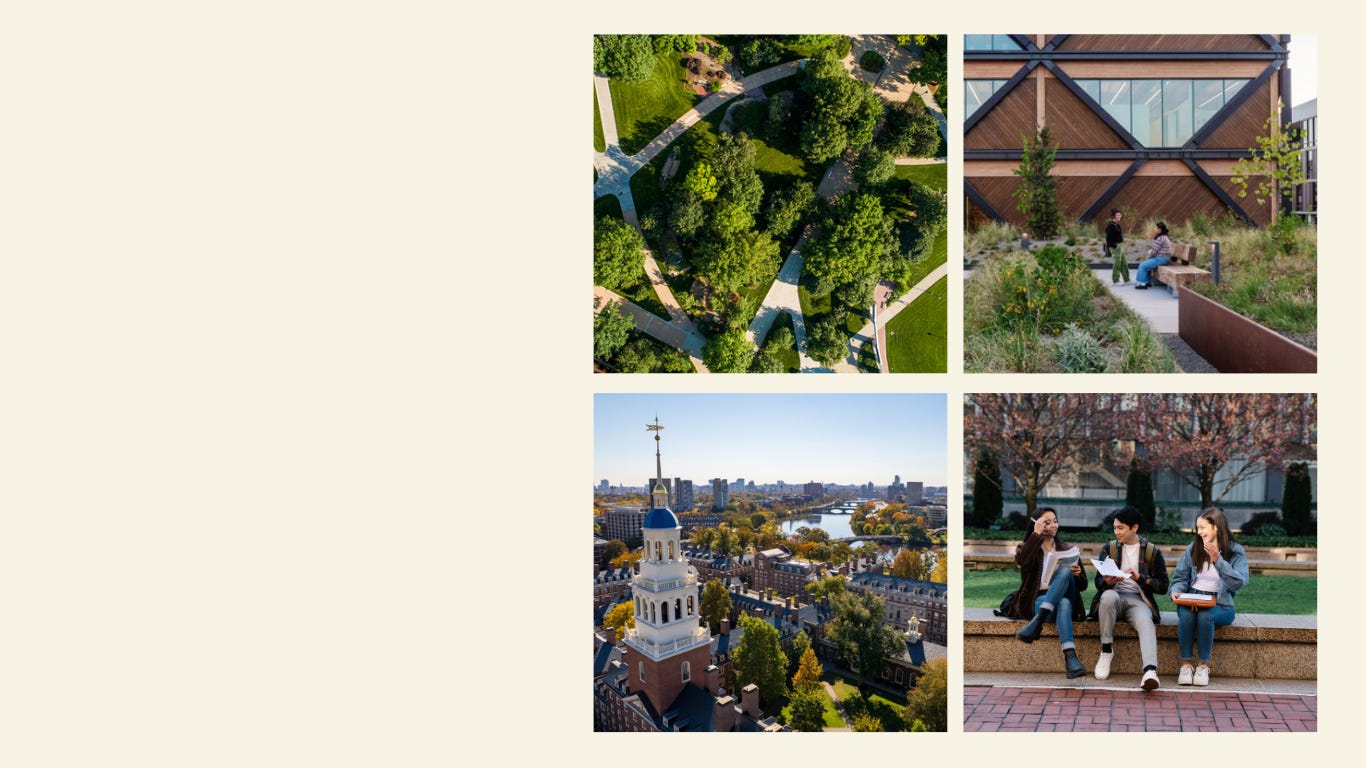
Melissa notes the amplitude of greenspace, tree canopy, and garden courtyards woven between the collegiate Gothic architecture.
The campus is dense, but a strong network of pedestrian & bike pathways connecting buildings within the campus, and between the campus and surrounding area, makes it feel united.
During her tour, Melissa observes that students are often found gathered together in active open spaces, something she frequently does with her friends in high school. She immediately recognizes that the FEEL of this campus is very different from the one she visited last week.
Situated in a rural area, the buildings on that campus were dispersed and felt more like satellites roaming around the stratosphere of an ill-defined, property. Despite its rural location, proportionately there was more hardscape than greenspace. It didn’t appear to have many convenient alternatives to driving, which may explain why Melissa observed so many students using cars to cut across campus. And while most of the buildings had been remodeled, the use of different architectural styles made it feel like the campus didn’t have a singular identity.
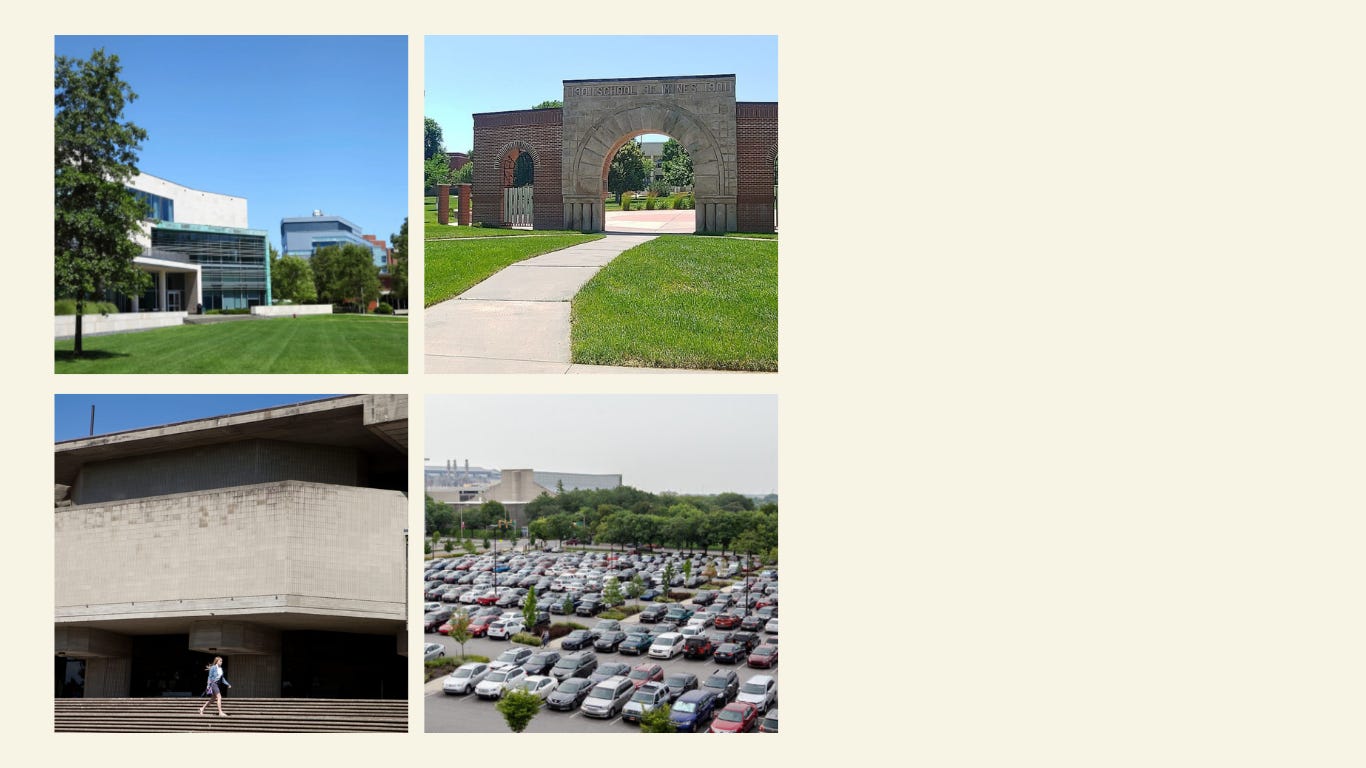
Despite the rural campus being a higher-ranked institution, Melissa ultimately chose to attend the urban university because she felt more at home and potentially accepted there.
I use the story of Melissa to illustrate how design can create an environment where a sense of connectedness thrives. Notice how Melissa’s choice wasn’t just about rankings or programs—it was about feeling "at home.”
Melissa’s experience is common to most students who feel a stronger sense of connectedness with one environment over another. Why did Melissa identify more with the urban campus? Arguably, it is because the urban campus better achieved a sense of interiority for her.
Interiority is a phenomenological perspective about the experience of the physical environment. There is a reciprocal relationship between a person affecting, and being affected by, external forces in their immediate surroundings. Interiority can be devised by manipulating the social, cultural, and organizational systems as well as the physical environment to create a ‘sense of place’ associated with positive feelings of safety and inclusion, contributing to a person’s subjective sense of belonging to a group. Interiority exists when people feel a sense of existential ‘insidedness’ and relatedness. Though subjective and complex, achieving a sense of interiority is not something to be trivialized.
The environment plays a significant role in mediating the learning process; the occupant-environment relationship is a powerful influencer of behavior and performance, particularly in an educational setting. When a student feels a sense of belonging in an educational environment they are more likely to exhibit perceptions that positively contribute to prosocial behavior such as sharing, comforting, or helping. Learning hinges on environments structured to encourage relatedness and students’ exposure to people different from themselves and with ideas different from those they currently hold[1]. In an environment where sense of relatedness is achieved, learning is more likely to occur. Therefore, creating moments of interiority should be a top priority for learning institutions.
What I explore is the phenomenological perspective of the college campus (which is just a fancy way of saying that I look at understanding someone's awareness or experience of something rather than the thing itself), and how it might be manipulated to improve feelings of safety, belonging, and relatedness.
[1] Ernest T. Pascarella. “How College Affects Students: Ten Directions for Future Research.” Journal of College Student Development 47, no. 5 (2006): 508-520.